
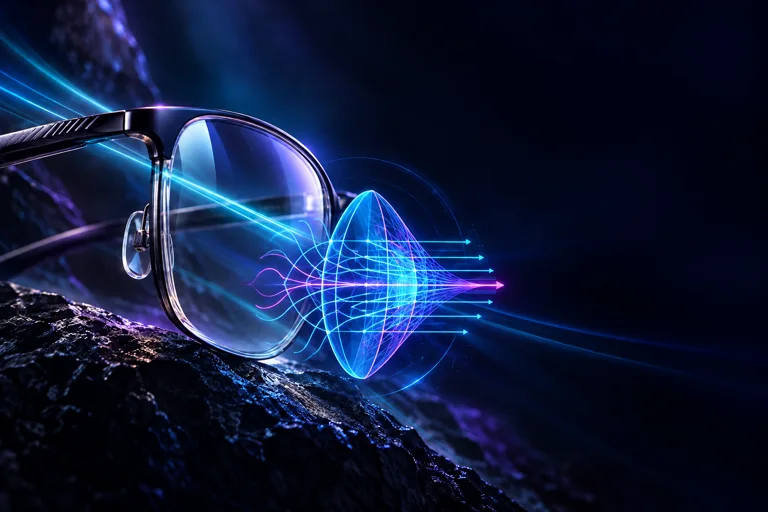
DuraTrace
Ray tracing and wavefront analysis in the actual position of wear
Read moreDuraTrace models the lens and eye in 3D in the actual position of wear; prescription and fitting inputs underpin ray-path analysis and wavefront optimisation.
Ray tracing and wavefront analysis in the actual position of wear
Modelling the lens and eye together
DuraTrace does not examine the lens separately from the eye. Its 3D model includes lens positioning in front of the eye—Position-of-Wear—to calculate the design from prescription and actual wearing geometry.
How are rays evaluated?
Rays are traced in different gaze directions, then the final wavefront is evaluated and optimised at the exit pupil using its actual dimensions. Analysis therefore includes multiple viewing directions rather than just one.
Design inputs
- The wearer's prescription: the basis of the required lens power.
- Back vertex distance (BVD): distance from the rear lens surface to the cornea.
- Pantoscopic angle: the frame's vertical tilt in its position of wear.
- Frame wrap angle: the frame's horizontal curvature.
- Working distance: the intended distance for the visual task.
How fitting affects the calculation
These are model inputs; accurate professional recording is part of design. DuraBase instead implements nominal power without position-of-wear recalculation. This is a calculation-method difference, not identical specifications across all DuraTrace models.
Products listed in the guide
Compare methods and explore the measurements
The supplied DuraTrace guide does not state a percentage improvement or individual-performance guarantee. Check orderable features on the product page.